
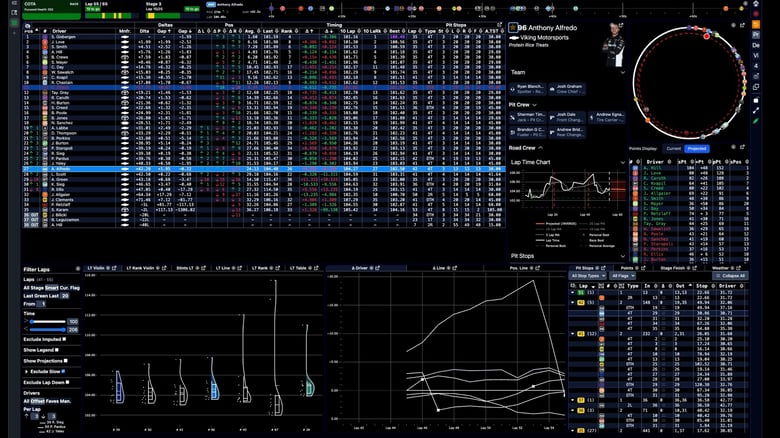
Galaxie Brings Immersive NASCAR Timing & Scoring To The Fans
A look at some of the features available in Braden Williams’ Galaxie NASCAR timing and scoring website.
By Seth Eggert, SWN Statistician & Staff Writer
MOORESVILLE, N.C. (March 12, 2026) – Data analyst and software engineer Braden Williams’ desire of wanting more information while watching NASCAR races led him to create his own unique timing and scoring system, Galaxie, which has drawn praise from journalists and industry members.
Most NASCAR fans have likely seen the scoring pylon on race broadcasts on FOX, NBC, Prime, The CW, TNT, or USA Network. Many of those same fans have also likely used the timing and scoring features on the NASCAR website or on the mobile app.
Williams was one of those many fans, having gravitated to NASCAR from following the world of Formula One in 2019.
As he started following the pinnacle of stockcar racing, Williams became a fan of NASCAR Hall of Famer Jimmie Johnson in the twilight of his career. However, following the then-Hendrick Motorsports driver wasn’t easy, as the No. 48 Ally Chevrolet Camaro ZL1 wasn’t always up front on the scoring pylon.
“Jimmie was down in the standings, and so he wasn’t getting a lot of TV time, wasn’t always up on the scoring pylon, but I still wanted to know what was going on with him and where things stood,” Williams recalled. “So, I used the NASCAR website for a while, but I wanted more.”
The desire to be able to follow more of the action, where his favorite driver was on track, and why the races unfolded as they did, had Williams drawing on his data analytics and software engineering background.
It was at that point that the Galaxie timing and scoring page was born. The name came from the Ford Galaxy, with a twist, as Williams wanted to get a good domain name for his creation.
“I figured out that I could pull all the data that NASCAR was using to drive nascar.com and started packing together something,” Williams explained. “That was more than five years ago, and it's evolved a lot since then.
“It started out really just as a simple timing and scoring page, just a live monitor of the table of where everybody was at, looking at deltas, a little bit more information. It's really evolved since then.”
The evolution from simple timing and scoring live leaderboard to what Galaxie is today was gradual. First came the addition of points projections, stage results, and pit stops. Then Williams added driver details, lap time comparisons, weather data, the ability to filter laps, a representation of a track map, and more.
Some of those features, such as the weather data, started simply as a predictor of when rain was approaching the track. That, like the other features, slowly expanded to include and showcase more and more of the real-time conditions during a given event.
“So the weather just started out as, ‘When’s the rain coming or is the rain coming?’” Williams stated. “But the cool thing, or the interesting thing about weather data is, if you're going to pull when the rain might be coming, you get everything else in the same bundle. It was really easy to go, ‘OK, well, what’s the temperature? What’s the wind speed? Where’s the wind coming from?’ I don’t necessarily look at that all the time, because a lot of the time it’s not important, but when it does matter – like at Bristol with tire temperatures – it does start to make an impact.”
Each piece of data that Williams has gathered, which comes from the same API system that NASCAR uses, fits into one of the many stories on track each race weekend.
From the flat tire that ended Chase Briscoe’s race to the two loose wheels that Ryan Blaney experienced at Phoenix (Ariz.) Raceway, Galaxie helps paint a picture of each driver, team, and crew member’s race day stories.
“The thing that has driven that evolution was really me going in the middle of a race, ‘Why is this happening or what just happened?’” Williams expressed. “There’s a piece of data or a couple pieces of data that exist together that can tell that story and make it easy for me to understand when that happens again or when that’s going to happen or get to that next layer down of, ‘Oh, this is what’s going on.’
“Then I would go and build that and add that in. As that went along, it made sense to start building out more flexibility [and] really make it so that it works in a lot of different places.”
The immersion that Galaxie creates grabbed the attention of The Athletic’s Jeff Gluck during the Autotrader 400 at Georgia’s EchoPark Speedway, who gave the race-tracking monitor a shoutout on social media.
The attention that Gluck’s post on X (formerly known as Twitter) brought to Galaxie briefly sent it to the garage under the DVP policy, as Williams joked. That same attention also brought several crew members to the website over the following weeks.
Brandon Hastings of TRICON Garage posted that “it rivals anything even the race teams use at the track.”
In addition to Galaxie being able to showcase real-time data, it also allows Williams to make projections about how the race season will likely unfold.
As a companion to the scoring monitor, the data analyst also has a blog that features driver ratings inspired by the iRating system that iRacing utilizes, a projection of how the Chase will unfold based on historical data, and more.
Williams is humbled by the attention that Galaxie has garnered in recent weeks. Although he wasn’t a fan of NASCAR in its most recent peak in the 1990s and 2000s, he does see the direction the sport is heading in.
“It’s great (to be able to help tell the story of each race),” Williams said. “I love the sport. I love to see the sport grow. I think there’s been so much going on off the track over the last four or five years, really. It seems like the sport’s really in a place now where it's ready to focus on growing itself and growing the fan base.
“I wasn’t around and a big fan in the late 90s [and] early 2000s, but we’re never going to get back to that same thing because that sort of monoculture just doesn’t exist anymore, right? There’s so much opportunity and I think so much excitement.
“I used to be a really big F1 fan from 2011 to about 2018. Then I kind of fell off because the racing was boring. I think there’s a big opportunity to attract people who are now interested in motorsports, continuing the growth of just motorsports in general,” Williams added. “NASCAR’s really poised to do that. If I can be one small piece of that big project, I’m really excited to be able to contribute to that.”
Through that vision and what Galaxie has become, Williams is pleased to be even a small part in the storytelling of each driver, team, crew member, and NASCAR race overall.
For more information and to utilize the Galaxie platform, visit https://galaxie.app/.
