
Into The Unknown: Inside Mick Schumacher's Move To IndyCar
By Thomas Hughes, SWN Staff Writer
INDIANAPOLIS (Jan. 12, 2026) – Mick Schumacher is Formula One royalty. But his time spent at the highest echelon of open-wheel racing was tantalizingly short, cut after two seasons with the then-branded UralKali Haas F1 Team.
However, mention the last name Schumacher to any fan who doesn’t know a single thing about racing, and the conversation inevitably turns toward Mick’s father, legendary seven-time Formula One driving champion Michael Schumacher.
The name is instantly recognizable, adding both allure and expectation, but also an unavoidable weight. Mick Schumacher doesn’t just race; he races with history attached, carrying the weight of being Michael Schumacher’s son, part of the family tied for the most F-1 championships alongside Lewis Hamilton.
That reality has followed Mick since the earliest days of his career. Every result, every mistake, and every missed opportunity has been measured not only against his peers, but against a standard that may never be replicated. It is unavoidable and undeniable that Mick Schumacher operates under more scrutiny and pressure than most drivers who reach the sport’s highest level.
He is the son of a seven-time champion, a note often repeated in Formula One, both to sponsorship success and a feeling of missed potential.
In 44 starts as an F-1 driver, Schumacher scored 12 points, the bulk of which came from one standout performance in the United Kingdom that briefly hinted at what might be possible with the right machinery.
Yet his tenure with Haas unfolded during one of the most difficult competitive stretches for any team on the grid. The car rarely allowed him to fight in the midfield, let alone for points, and development limitations often left Schumacher racing more against circumstance than rivals.
In a sport that demands immediate results, patience is rarely extended, even to a Schumacher. In his first year, 2021, Schumacher struggled to get anywhere near the top-10.
That was primarily down to the fact that the Haas-Ferrari was the worst car on the grid, consigned to being the 10th-strongest team every weekend.
In his second season, things got better for a time. Schumacher finally found his way into the points at the 2022 Lenovo British Grand Prix, working his way into a then-career-best eighth place and even fighting with Red Bull’s Max Verstappen on the final lap for seventh, though the fight proved ultimately unsuccessful.
The following race at Austria was again fruitful; Schumacher qualified seventh, one spot behind teammate Kevin Magnussen, and piloted his Haas to a career-best sixth. That day, he finished behind only Charles Leclerc (Ferrari); Verstappen (Red Bull); the two Mercedes cars of George Russell and Hamilton, who moved to Ferrari ahead of 2025; and Alpine’s Esteban Ocon.
But Schumacher did not score again, and following crashes earlier in the season at Saudi Arabia, Miami, and Monaco, Schumacher did not retain his role at Haas, being replaced in favor of German Nico Hulkenberg.
Following the 2022 season, Ferrari’s driver academy cut ties with Schumacher, with Mercedes subsequently bringing Schumacher on as a reserve driver.
After his exit from the grid, Schumacher remained close to Formula One through reserve roles and simulator work with Mercedes, but a full-time return didn’t materialize. Instead, the next phase of his career is taking him across the Atlantic, to a series that offers something F-1 does not: reinvention.
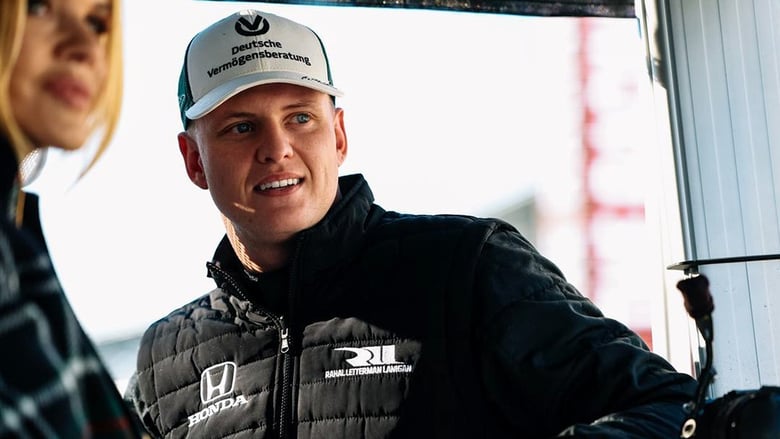
Schumacher will compete in the NTT IndyCar Series, piloting the No. 47 Rahal Letterman Lanigan Racing Honda. In doing so, he effectively assumes the seat of the No. 30 entry driven by Devlin DeFrancesco in 2025, stepping into a program seeking stability and upward momentum.
The move represents a significant shift, both geographically from the European-dominated F-1 scene, but also in a philosophical sense, as well.
“For me, it was important not to do a half thing but actually go in and do it 100 percent,” Schumacher said on Nov. 25 during his introductory press conference with RLL. “I wouldn’t be here if I wasn’t fully committed.”
IndyCar presents a fundamentally different challenge. Gone are the hyper-specialized circuits and relentless technical arms race of Formula One. In their place are varied track types, closer competition and a style of racing that demands adaptability and race craft as much as outright speed.
Most notably, IndyCar introduces Schumacher to ovals: something entirely foreign to his professional racing résumé.
For Schumacher, it will be his first sustained exposure to racing where turning left is the only option, lap after lap, with margins measured in inches and consequences amplified by proximity. Ovals require trust in the car, in the setup and in the drivers often inches from you, forcing competitors to rethink how they manage tires, traffic and risk.
Yet, Schumacher has downplayed the novelty. The challenge, as he frames it, is not about redefinition, but about simplifying the objective. Just drive. Strip away the noise, the legacy, the comparisons, and the expectations, and the task becomes what it has always been: extracting performance from the car in front of him.
“Of course, it’s something that I’ve been thinking about,” Schumacher said of oval racing. “But on the other hand, I think motorsports on the whole is dangerous, so I don’t really see why that one thing should be more dangerous than anything else. Obviously, there’s been multiple things, and Jay [Frye, former president of IndyCar] has been a big part of that, in making oval racing or just racing in IndyCar safer. Therefore we've had multiple conversations about that, and they've all been positive to my ears. So yeah, that's why I ultimately took the decision [to move to IndyCar]. … Of course, it's not to be taken on the easy shoulder.
“I don’t take it on the easy shoulder. I think that it is crazy speeds; it is super quick. We’re obviously racing hard side by side. But I accept the risk for the enjoyment of the racing’s sake.”
That philosophy aligns with much of Schumacher’s development path. Despite the inescapable presence of his father’s legacy, Mick’s career has been built deliberately. He won the Formula Two championship in 2020 through consistency rather than dominance, and he steadily climbed the ladder without shortcuts.
In 2019, he joined the Ferrari Driver Academy, further tying his journey to one of the most iconic names in motorsport and to the team most closely associated with his father’s greatness.
Those connections were both a blessing and a burden. Ferrari provided opportunity, resources, credibility and a door to F-1 through its customer team, but it also reinforced expectations that were never entirely fair.
Mick Schumacher was never going to be Michael Schumacher. He was always going to be Mick.
IndyCar may finally provide the space for that reality to shine. To some extent, names matter less than results, and careers can be rebuilt, rather than defined by early outcomes.
For Schumacher, it represents a chance not to escape his past, but to coexist with it, to compete without the constant shadow of comparison.
The move is a recalibration. It’s a chance to prove that the younger Schumacher’s identity as a driver extends beyond his surname, beyond Formula One, and beyond expectations that were never fully his to carry.
Now, Schumacher’s focus turns wholly towards the incoming pre-season tests and to the season opener, coming March 1 with the Firestone Grand Prix of St. Petersburg.
“I think we’re all very keen to get the season going,” Schumacher said. “I think there’s plenty of work still to be done to get me up to speed, but I believe that’s why everything has gone so smoothly already.”
In IndyCar, Mick Schumacher doesn’t need to be a legend. He just needs to race.
“I think [IndyCar] reminds me a little bit of good old karting days, pretty similar to how WEC [World Endurance Championship sports car] racing was,” Schumacher said. “There's a lot of side-by-side and maybe a little touch here and there. From what I understand, the cars are pretty robust, as well, when it comes to side-by-side action.
“I’m just purely excited for the great racing that there will be and the fun that will bring up and create.”
